
Air Duct Cleaning in Springfield, MA
Air duct cleaning in Springfield, MA typically costs $280–$580 for a standard residential system, with most jobs taking 3–5 hours. If you live in a triple-decker near Walnut Street or a Victorian off Sumner Avenue, your ductwork likely needs more than a surface vacuum — it needs a technician who understands what 1960s retrofit jobs look like from the inside. Call (888) 597-5659. We’ve spent 11 years focused on one thing, and Springfield’s older housing stock is where that depth matters most.
Why Springfield Homes Are Different
Springfield sits in the Connecticut River Valley, a low corridor that traps summer humidity and sees wide seasonal swings. The bulk of the city’s housing stock dates from 1900 to 1955 — triple-deckers, two-families, and Victorian single-families concentrated in the South End, North End, and Forest Park. Most were heated with gravity-fed “octopus” furnaces or steam boilers before being converted to forced-air in the postwar decades. Those conversions produced large, poorly-fitted trunk-and-branch systems crammed into spaces never designed for them, with numerous uninsulated and unsealed connections that accumulate debris and moisture over decades. The Connecticut River Valley’s muggy summers regularly push dew points high enough to cause condensation inside duct systems during spring and fall transitions, allowing biological growth to establish before heating season begins.
Air Duct Cleaning in Springfield

Springfield’s neighborhoods — the North End, South End, and Indian Orchard in particular — are packed with early-1900s triple-deckers and two-family worker cottages that had forced-air ductwork awkwardly retrofitted into wall chases and unfinished basements in the 1960s–1980s. Those makeshift duct runs are riddled with unsealed joints and sit in damp, unconditioned spaces fed by the valley’s characteristically humid summers, making mold-colonized ductwork a defining problem here that technicians working in drier or newer suburban markets simply don’t encounter at the same frequency or severity. Air Duct Cleaning from Everest means Scott handles every job personally, with equipment that matches the challenge.
Residential Duct Cleaning
Springfield’s residential market is dominated by pre-1955 housing. When gravity furnaces were ripped out and ductwork was retrofit into wall chases and unfinished basements, the results were functional at best. We regularly find systems where a standard residential cleaning quote underestimates the actual scope by half. That’s why Scott starts every Springfield residential job with a video inspection — no surprises, and no pushing equipment through connections that can’t handle it. Standard residential duct cleaning runs $280–$420 for a single system with up to 10 vents; full system cleaning with video inspection ranges $380–$580.
Commercial Duct Cleaning
Springfield’s commercial buildings along Main Street and in the Metro Center corridor present different challenges: older HVAC infrastructure, mixed-use occupancy, and the need to work around business hours. We’ve cleaned duct systems in restaurants, small medical offices, and retail spaces where the original 1950s ductwork has been extended piecemeal across multiple tenant improvements. Our Nikro HEPA vacuums and Abatement Technologies air scrubbers let us work during operating hours without filling your space with disturbed particulate. Commercial duct cleaning runs $520–$890 per HVAC unit.
Why do Springfield triple-decker duct systems develop mold more than in nearby towns like Longmeadow?
The Connecticut River Valley traps humidity, and Springfield’s dense concentration of pre-1955 housing means most duct systems were retrofit into unconditioned basements and wall chases with minimal sealing. Longmeadow’s newer stock and higher elevation mean drier conditions and better-original construction. If you’re in a Springfield triple-decker, expect to need more aggressive sealing and possibly sanitizing — call (888) 597-5659 and we’ll show you exactly what you’re dealing with.
Dryer Vent Cleaning in Springfield

Dryer vent cleaning in Springfield typically costs $140–$280, with most appointments scheduled within 24–48 hours. Scott handles every job personally, so the person who answers your call is the same technician who’ll be in your basement with a Rotobrush and a Nikro HEPA vacuum. In the North End and South End triple-deckers, we regularly find dryer vents sharing wall chases with plumbing stacks — a configuration that traps moisture and creates hidden fire hazards no surface inspection would catch. Dryer Vent Cleaning from Everest includes inspection, mechanical cleaning, and airflow verification.
Vent Cleaning
This is where our Rotobrush system earns its keep. Springfield’s older duct materials — galvanized steel with rough interior seams, collapsed flex duct, improvised transitions — hold lint differently than modern smooth-wall venting. We match the brush head and vacuum strength to what we’re actually encountering, not to a one-size-fits-all protocol. In Indian Orchard two-families, we often find vents that haven’t been cleaned in a decade or more, with lint compaction so dense it requires multiple passes. Standard single-family vent cleaning runs $140–$200; triple-decker or two-family units typically fall in the $180–$280 range.
Vent Rerouting
Vents terminating in unheated basements violate current code and create humidity problems in spaces that are already damp in Springfield’s climate. We’ve successfully rerouted South End cottage vents to direct exterior termination, shortening runs and eliminating the basement moisture source. Vent rerouting with materials and labor runs $320–$550. The feasibility study is part of our free estimate — call (888) 597-5659 and we’ll assess your specific layout.
How often should I have my dryer vent cleaned in an Indian Orchard two-family?
Every 12 months for Indian Orchard two-families, and possibly more frequently if you have a large household or run multiple loads daily. The older duct systems common in these properties — often retrofitted flex duct with minimal slope and multiple bends — accumulate lint faster than modern smooth-wall installations. Shared laundry facilities in two-families also see heavier use per unit than single-family setups. Annual cleaning prevents the 70% airflow reductions that create fire hazards and energy waste. Call (888) 597-5659 to schedule.
HVAC Cleaning in Springfield

HVAC cleaning in Springfield typically costs $280–$650 for a full system service, with most residential jobs completed in a single visit. If you’re smelling musty air when the heat kicks on or noticing weak airflow from your vents, dirty ductwork and coils are usually the culprit — and in Springfield’s older housing stock, the problem often runs deeper than a standard vacuuming can fix. HVAC Cleaning from Everest means we clean it, repair it, and seal it, not just vacuum over the symptoms.
Evaporator Coil Cleaning
The evaporator coil is where your system actually conditions the air — and where mold and biofilm love to colonize in Springfield’s humid valley climate. We pull the coil assembly, clean it with foaming agents and low-pressure rinses that won’t damage delicate fins, and inspect the drain pan for standing water. In Springfield’s older homes, we frequently find coils choked with dust that’s been recirculating through poorly filtered, leaky ductwork for years. Evaporator coil cleaning alone runs $180–$320.
Air Handler Cleaning
The air handler is the heart of your forced-air system — blower motor, housing, and filter rack. In Springfield’s converted triple-deckers, air handlers often sit in damp, unfinished basements where they draw in musty air through gaps in the return plenum. We disassemble and clean the blower wheel (which can be 30% less efficient when caked with debris), vacuum the housing, and seal leaks in the return path. Air handler and blower cleaning runs $220–$380; full residential HVAC cleaning for a single system ranges $280–$450, with triple-decker and multi-family jobs at $380–$650 due to access challenges.
I smell a musty odor when the heat kicks on in my Forest Park Victorian — is that just dust or something worse?
It’s likely mold or mildew colonizing damp duct sections, not ordinary dust. Springfield’s Connecticut River Valley humidity feeds biological growth in uninsulated duct runs, especially in Forest Park’s Victorian-era homes with basement air handlers drawing from damp crawlspaces. Dust smells stale; mold smells actively musty and often triggers allergy symptoms when the system cycles. We inspect with borescope cameras to locate the source, clean affected sections, and apply antimicrobial treatment where needed. Call (888) 597-5659 for an assessment.
Duct Repair & Sealing in Springfield
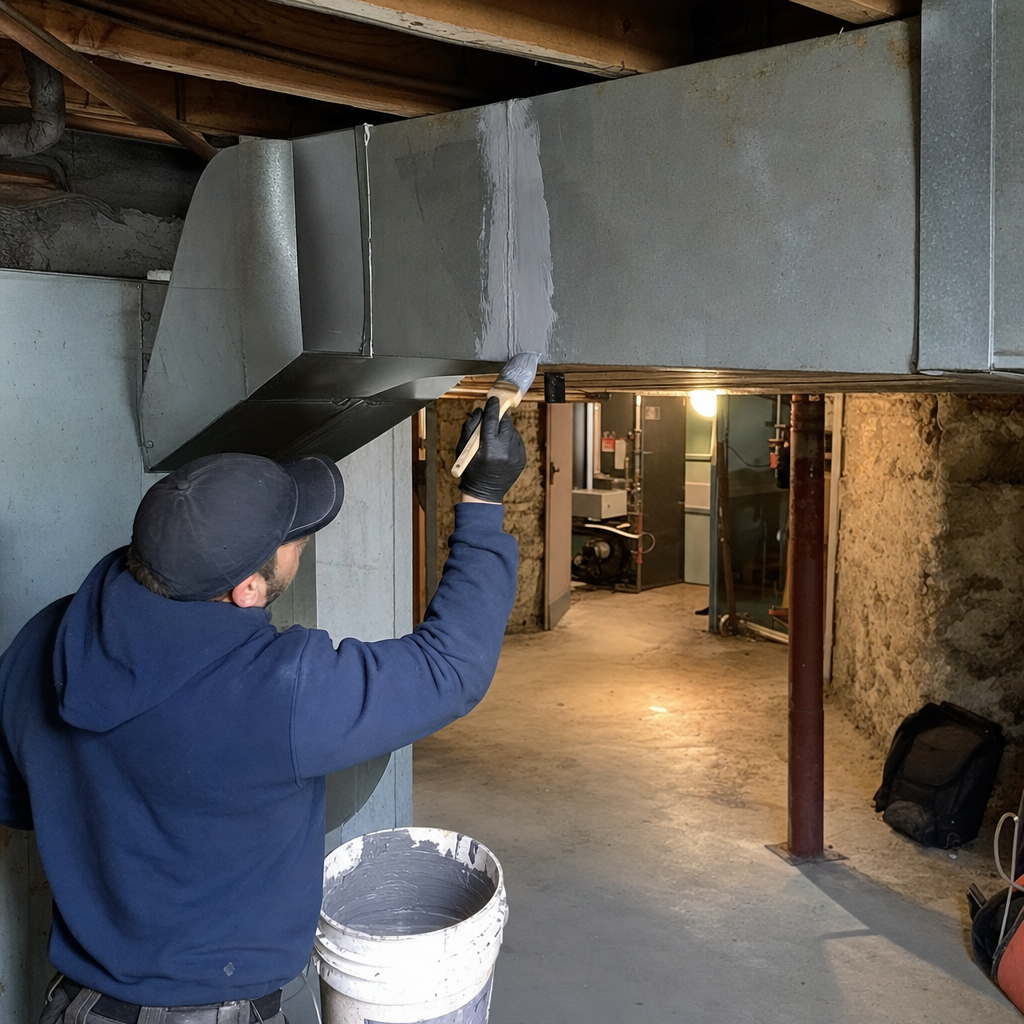
Duct repair and sealing in Springfield typically costs $280–$650 for most residential jobs. We’re familiar with the specific challenges that Springfield’s older housing stock presents — from the triple-deckers of the North End to the converted two-families in Indian Orchard. Scott Gray, our owner and lead technician, has spent 11 years inside duct systems exactly like yours. Duct Repair & Sealing from Everest addresses the root cause, not just the symptom.
Duct Sealing with Mastic Sealant
Springfield’s humid basement environments destroy standard duct tape within months. We see it constantly: brittle, peeling tape that was someone’s weekend project five years ago, now allowing conditioned air to leak into wall cavities and drawing musty basement air back into the system. Our mastic sealant application is different — it’s a fiber-reinforced compound that remains flexible and adheres to galvanized steel, flex duct, and sheet-metal transitions even in damp conditions. Partial system mastic sealant application runs $280–$420.
Flex Duct Repair
Flex duct installed during Springfield’s 1970s–1980s forced-air conversions is reaching the end of its service life. The plastic liners become brittle, the insulation compacts, and the sagging runs collapse under their own weight — especially in the long horizontal spans common in triple-decker basement chases. Last spring, we responded to a duct repair call on Dwight Street in the South End where mold-colonized flex duct had collapsed from decades of moisture buildup. We replaced the compromised flex with rigid metal, sealed all transitions with mastic, and insulated the trunk lines. Flex duct replacement per run runs $180–$340; metal duct repair and section replacement ranges $260–$480.
Will sealing ducts reduce the musty smell in my North End triple-decker?
Yes, proper sealing typically reduces musty odors significantly by eliminating the negative pressure that draws basement and wall-cavity air into your system. In North End triple-deckers, unsealed joints in shared wall chases are particularly prone to pulling in odors from neighboring units and damp structural spaces. We combine sealing with sanitizing when biological growth is present, addressing both the air leakage path and the source contamination. Call (888) 597-5659 to schedule a free assessment.
Air Quality & Sanitizing in Springfield
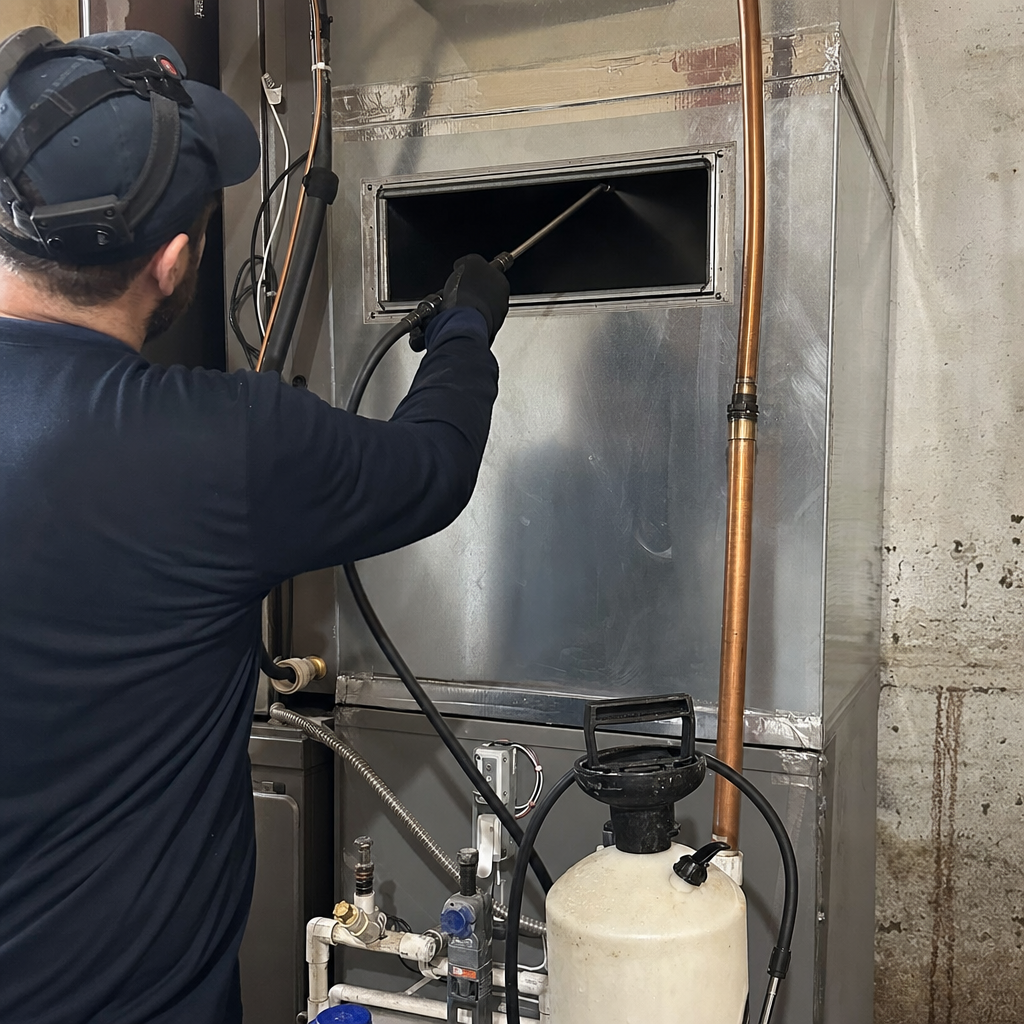
Professional air duct sanitizing in Springfield, MA typically costs $350–$850 for a standard residential system, with mold treatment and UV light installation running higher in the city’s older triple-deckers and two-family homes. Most jobs are completed in a single day, though Springfield’s patchwork duct systems often require more time than suburban equivalents. Air Quality & Sanitizing from Everest means we treat the full system, not just what we can reach easily.
Mold Treatment
Mold in Springfield ducts isn’t a surface problem — it’s a systemic one. The city’s early-1900s triple-deckers and two-family worker cottages often have ductwork that is a multi-decade patchwork: 1940s galvanized steel trunk lines spliced into 1970s flex duct with sheet-metal scraps and duct tape, all running through shared wall chases that also contain plumbing, making access extremely tight and requiring custom access cuts. We treat the full system and identify the moisture source so it doesn’t return. Mold treatment for a single system runs $450–$950.
Bacteria Sanitizing
Springfield’s valley location means muggy summers and wide seasonal swings. Dew points climb high enough to cause condensation inside duct systems during spring and fall transitions, when residents run neither heat nor AC. That moisture allows bacteria to establish before the next heating season begins. We apply EPA-registered sanitizers through the full duct run, with particular attention to the flex-duct sections common in retrofitted Springfield homes, where porous surfaces trap biological material that rigid steel doesn’t. Bacteria sanitizing typically costs $350–$650.
Will a UV light system work in the older duct systems we see in Indian Orchard?
Yes, but installation requires assessment of the specific duct geometry. The irregular layouts in Indian Orchard’s converted worker cottages sometimes need dual-lamp configurations or strategic placement near the furnace rather than mid-duct. We’ve installed Aprilaire and Honeywell UV systems successfully in dozens of Springfield-area homes with 1960s–1980s retrofit ductwork. The key is matching lamp output and placement to airflow patterns, which we measure during our pre-installation inspection. Call (888) 597-5659 for a free estimate.
Brands We Service in Springfield
We use Rotobrush brush-system technology, Nikro HEPA vacuums, and Abatement Technologies air scrubbers — the same equipment commercial contractors rely on, not consumer-grade alternatives. For sanitizing and filtration, we work with Honeywell, Aprilaire, and Guardsman. Parts are stocked for common Springfield systems, and most repairs don’t require a return visit. our brands
Pricing for Air Duct Cleaning in Springfield, MA
| Service | Typical range in Springfield |
|---|---|
| Standard residential duct cleaning (single system, up to 10 vents) | $280–$420 |
| Full system cleaning with video inspection | $380–$580 |
| Triple-decker / complex retrofit systems | $450–$720 |
| Mold remediation and sanitizing add-on | $180–$340 |
| Commercial duct cleaning (per HVAC unit) | $520–$890 |
| Standard single-family dryer vent cleaning | $140–$200 |
| Triple-decker or two-family dryer vent cleaning | $180–$280 |
| Standard residential HVAC cleaning (single system) | $280–$450 |
| Triple-decker / multi-family HVAC cleaning | $380–$650 |
| Mastic sealant application (partial system) | $280–$420 |
| Bacteria sanitizing (standard residential) | $350–$650 |
| Mold treatment (single system) | $450–$950 |
Springfield’s older housing stock pushes most jobs toward the higher end of these ranges. A Forest Park Victorian with original plaster and a 1970s duct retrofit simply takes longer than a 1990s ranch in Longmeadow. We don’t quote flat rates that force technicians to rush or cut corners — Scott assesses on-site, shows you the video, and gives you a fixed price before work begins.
Neighborhoods We Serve in Springfield
We work across Springfield’s full range of neighborhoods, from the dense triple-deckers of the North End to the leafy Victorians of Forest Park. Most Springfield appointments are scheduled within 24–48 hours of your call.
- North End
- South End
- Forest Park
- Indian Orchard
- Metro Center
Service Area — Cities Near Springfield
Everest Air Duct Cleaning Service Massachusetts serves Springfield, MA and surrounding communities throughout the Connecticut River Valley. We regularly work in Longmeadow, MA and West Springfield, MA to the south and west, Chicopee, MA and North Chicopee, MA to the north, and Agawam, MA to the west. Scott handles every job personally, so your technician travels from our Massachusetts base with the full equipment load needed for your specific system.
Serving Springfield, MA — Our Local Coverage Area
We’re based nearby and serve all of Springfield, MA. The map shows the Springfield coverage area; if your address is on it, we can help.
Also serving nearby: Springfield, MA, Longmeadow, MA, West Springfield, MA, Chicopee, MA, North Chicopee, MA, Agawam, MA.
FAQs About Air Duct Cleaning in Springfield
Most residential duct cleaning and sealing doesn’t require a permit, but significant duct replacement or modifications to the HVAC plenum may need Springfield Building Department approval. We handle permit determination as part of our assessment and will advise you if your specific job requires filing. For standard cleaning and sealing, we proceed without delay. Call (888) 597-5659 with questions about your project.
We typically schedule Springfield appointments within 24–48 hours, including the 01129, 01138, 01139, and 01144 ZIP codes. Scott handles every job personally, so we don’t overbook — we confirm a specific arrival window when you call. For complex triple-decker or commercial jobs, we may schedule a brief site visit first to confirm scope and equipment needs. Call (888) 597-5659 to book.
Ready to improve the air quality in your Springfield home? Call (888) 597-5659 for a free, on-site estimate. Scott handles every job personally, and we use Rotobrush and Nikro equipment on every Springfield property we service. 617 customers have rated us 4.9 stars — we’d welcome the chance to earn your trust too.
What happens when you call
- 1A real person answersNo phone trees — talk to a local air duct cleaning pro.
- 2You get an upfront price rangeHonest numbers before anyone is dispatched. No surprises.
- 3We come out and measureLicensed & insured, at a time that suits you — the visit and the quote are both free.
- 4You get the price in writingLine-itemed, yours to keep, and nothing starts until you say go.
What Springfield Customers Say
"Job was done well and the house smells better. There was some dust knocked loose around a couple of the registers that I had to wipe down afterward."
— Kevin Park"Quoted per system rather than the bait and switch per vent pricing everybody else in town uses. The number I was told on the phone was the number on the invoice."
— Rami Hassan"Found a disconnected run in the crawlspace while they were in there and told me about it rather than cleaning around it."
— Aisha Boyd