
Fast, Reliable Air Quality & Sanitizing Across Reading
Air quality and sanitizing services in Reading typically run $280–$650 for whole-home treatment, with most jobs completed in a single visit. If you’re noticing musty odors when the heat kicks on, worsening allergies, or visible debris around your vents, the problem often traces back to original ductwork that’s been accumulating contaminants since the Eisenhower administration.
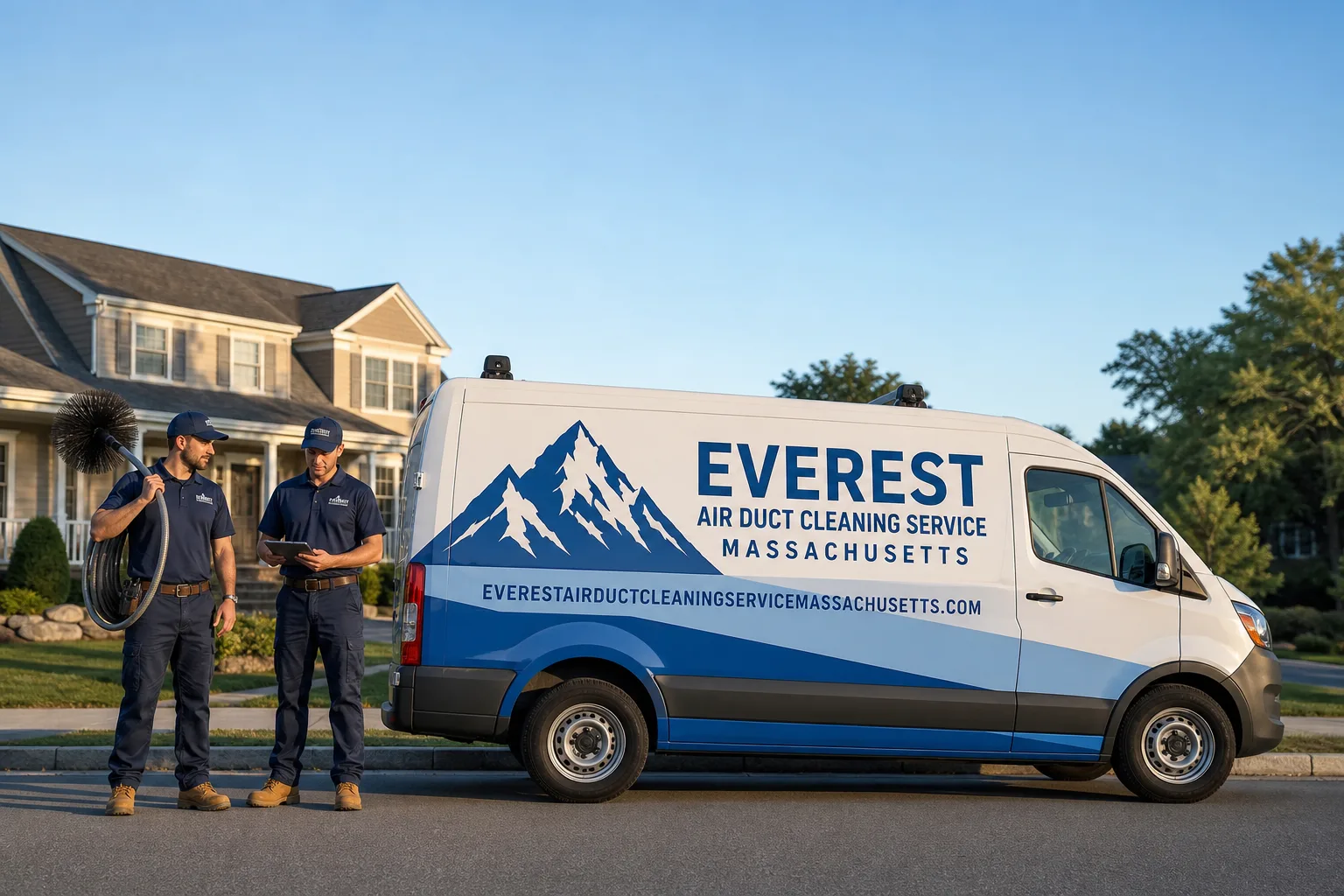
We’re Everest Air Duct Cleaning Service Massachusetts, and we’ve spent 11 years working inside the exact housing stock that dominates Reading — the Cape Cods along Nashoba Road, the ranches off Summer Avenue, the split-levels near Franklin Street. Scott Gray handles every job personally as lead technician, so when you call (888) 597-5659, the person answering is the same one who’ll be in your basement or knee-wall chase. We carry our Air Quality & Sanitizing equipment — Rotobrush brush systems, Nikro HEPA vacuums, Abatement Technologies air scrubbers — from our Boston base up Route 128 to Reading homes, usually same-day or next-day.
Why Everest Air Duct Cleaning Service Massachusetts Is Reading’s Preferred Air Quality & Sanitizing Company
Reading homeowners have left us 617 verified reviews averaging 4.9 stars, and we notice the feedback patterns: customers mention Scott by name, cite specific neighborhoods like Lakeview Avenue and Willow Street, and remark that we found problems three previous companies missed. That happens because Scott handles every job personally — no rotating subcontractor crews, no franchise dispatchers guessing at local conditions.
Our response time to Reading is consistently same-day or next-day because we’re not driving in from the western suburbs or down from New Hampshire. We know the difference between a 1952 Cape Cod on Lowell Street with a knee-wall chase that’s never been opened and a 1970s ranch on Main Street with flex-duct sagging in the basement. That local fluency means faster diagnosis, no wasted diagnostic time, and solutions that actually match your home’s construction era.
We’ve also learned which Reading-specific problems repeat: fiberglass liner degradation in original ductwork, rodent infiltration in sealed chases, and patchwork retrofits in colonials near downtown that create moisture traps. When you’ve seen the same failure modes across dozens of Reading homes, you stop treating symptoms and start fixing sources.
Our Air Quality & Sanitizing Services in Reading
Mold Treatment
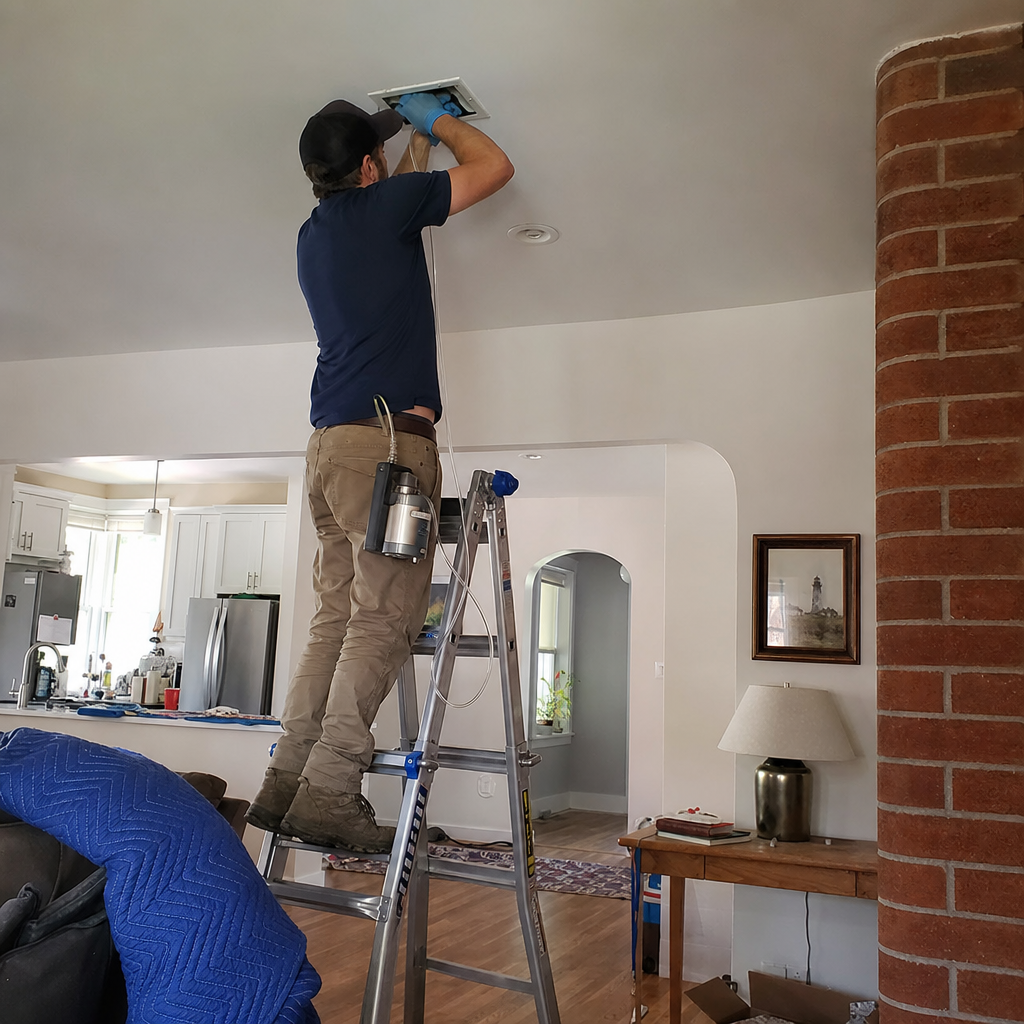
Reading’s six-month heating season and humid summers create ideal conditions for mold inside unconditioned duct spaces. We treat active mold with EPA-registered bactericides applied through pressurized fogging equipment, then install Abatement Technologies air scrubbers during the process to prevent cross-contamination. In Cape Cod knee-wall chases — common along Nashoba Road and Willow Street — we frequently find mold colonizing degraded fiberglass liner where condensation accumulates against roof sheathing. We don’t just kill visible growth; we identify the moisture source, whether it’s a chase venting failure or thermal bypass, so the mold doesn’t return next season.

Bacteria Sanitizing
Whole-home bacteria sanitizing in Reading runs $320–$480 for typical 1,500–2,500 square foot homes. We use hospital-grade disinfectants compatible with Honeywell and Aprilaire filtration systems, applied as a fine mist that penetrates the full duct run without leaving residue on your registers or furniture. This service matters most for Reading homes with original ductwork that’s never been properly cleaned — decades of organic debris create a bacterial load that standard vacuuming won’t address. After sanitizing, we verify reduced microbial counts with ATP surface testing on a representative sample of duct interior.

Odor Removal
That musty “old house” smell when your Reading furnace fires up? It’s usually not “just how old houses smell.” We trace odor sources using borescope cameras and smoke-pencil testing, then match the treatment to the cause: thermal fogging for absorbed organic odors, oxidizing agents for rodent decomposition, or activated carbon filtration for volatile compounds from deteriorating duct materials. We serviced a 1961 ranch on Summer Avenue where the homeowner reported musty odors whenever the heat kicked on. Inside a sealed knee-wall chase above the living room, we found the original fiberglass liner had delaminated, shedding glass fibers into the airstream, and a mouse nest had been decomposing for years. We installed a HEPA-filtered Rotobrush access port, sanitized with an EPA-registered bactericide, then sealed the chase with a UV-stable coating to prevent future liner degradation.

UV Light Installation
UV-C lamp installation in Reading’s older homes requires careful placement — too close to plastic duct components and you get UV degradation; too far from the coil or filter and you lose efficacy. We size and position UV systems based on your specific duct geometry, typically installing upstream of the coil in the main return plenum. For Reading’s 1950s–’70s homes with limited mechanical room access, we often recommend in-duct units from Honeywell or Aprilaire rather than coil-mounted systems that require more clearance. Installed cost ranges from $380–$620 depending on duct configuration and whether we need to fabricate a custom mounting bracket.

Air Purifier Install
Whole-home air purifiers integrate with your existing HVAC system, filtering recirculated air rather than treating the room you’re standing in. For Reading homes with original ductwork, we emphasize that purification complements — doesn’t replace — duct cleaning and sealing. We install Honeywell and Aprilaire units sized to your system’s CFM, with MERV 13–16 filtration that captures the pollen, pet dander, and fine particulate common in Reading’s tree-heavy neighborhoods.

Allergen Reduction
Reading’s dense oak and maple canopy produces heavy pollen loads, and when combined with original fiberglass-lined ductwork, you get a reservoir effect: particles enter through return leaks, adhere to degraded liner surfaces, and recirculate for months. Our allergen reduction protocol combines mechanical agitation with Rotobrush technology, HEPA extraction through Nikro vacuums, and optional sealing of degraded liner with Guardsman encapsulant. For homes on Franklin Street and similar split-level neighborhoods, we pay particular attention to basement return plenums that often draw from unfinished spaces loaded with dust and pest debris.

What happens when you call
- 1
A real person answersNo phone trees — you reach a local pro.
- 2
You get an upfront price rangeHonest numbers before anyone is dispatched.
- 3
A background-checked tech heads outLicensed & insured, dispatched right away.
- 4
You approve before work beginsNothing starts until you say go.
Trusted Brands We Service in Reading
We don’t show up with a shop-vac and good intentions. Our Rotobrush brush systems and Nikro HEPA vacuums are the same equipment commercial contractors use in hospitals and schools — not consumer-grade tools rebranded for residential marketing. For sanitizing and filtration, we work with Honeywell, Aprilaire, and Abatement Technologies products we can source quickly through our Boston-area suppliers, meaning Reading customers aren’t waiting weeks for specialized filters or UV lamps. When we recommend a Guardsman liner encapsulant for your degraded fiberglass ductwork, it’s because we’ve tested its adhesion and durability in Reading’s specific temperature and humidity cycling — not because it’s the cheapest option in a catalog.
Common Air Quality & Sanitizing Problems We See in Reading Homes
- Fiberglass liner in original ductwork degrades and sheds particulates into the air supply, especially in unconditioned knee-wall spaces. Reading’s 1950s–’70s Cape Cods were built with fiberglass-lined sheet metal ducts that weren’t designed for 60+ years of thermal cycling. The binder breaks down, fibers release into the airstream, and occupants experience chronic respiratory irritation they attribute to “allergies” or “getting older.”
- Sealed duct chases in Cape Cods are never accessed after construction, allowing decades of dust and rodent debris to accumulate. On Nashoba Road and Willow Street, we’ve cut access panels into chases that haven’t been opened since 1962 and found compressed debris reducing effective duct diameter by 30% or more — plus the biological loading that comes with mouse activity.
- Patchwork retrofits in older colonials near downtown create hidden junctions that trap moisture and mold. Lowell Street and Main Street homes converted from gravity heat to forced air often have transitional ductwork with unsupported flex runs, unsealed takeoffs, and low points where condensate pools — perfect conditions for mold growth that standard cleaning can’t reach.
- Six-month heating seasons pull massive debris volumes through ductwork far more aggressively than milder climates. Reading’s furnaces run hard from late October through April, and every cycle draws attic dust, basement particulate, and degraded liner material deeper into the system. By March, supply registers in homes with original ductwork often show visible black staining.
Pricing for Air Quality & Sanitizing in Reading, MA
| Service | Typical Range in Reading | What Affects Cost |
|---|---|---|
| Whole-home bacteria sanitizing | $280–$420 | System size, access difficulty, pre-cleaning required |
| Mold treatment (localized) | $340–$580 | Extent of growth, chase access needs, post-treatment verification |
| Odor removal protocol | $320–$520 | Source complexity, number of treatment stages, filtration add-ons |
| UV light installation | $380–$620 | Duct geometry, electrical routing, brand selection |
| Air purifier (whole-home) | $450–$890 | Unit capacity, filter type, integration complexity |
| Allergen reduction (with encapsulation) | $520–$780 | Liner degradation extent, chase access cuts, sealing material |
These ranges reflect Reading’s typical 1,500–2,800 square foot homes with one or two HVAC zones. Costs edge higher when we need to cut secondary access into sealed knee-wall chases — common on Lakeview Avenue and in Cape Cod neighborhoods — or when degraded liner requires full encapsulation rather than standard cleaning. We provide exact quotes after visual inspection, never over the phone with unseen variables. Estimates are free, and Scott Gray performs the inspection himself so you get pricing from the person who’ll do the work. Call (888) 597-5659 to schedule.
We Also Serve Cities Near Reading
Our service radius extends naturally to Wakefield, Stoneham, North Reading, and Woburn — towns with similar post-war housing stock and identical climate challenges. We route efficiently from our Boston base up I-93 and Route 128, so Wakefield customers on the eastern edge of our coverage and Woburn customers to the south get the same response times as Reading. Each city gets the same owner-led service: Scott Gray on every job, the same Rotobrush and Nikro equipment, the same neighborhood-specific expertise applied to local building eras.
Serving Reading, MA — Our Local Coverage Area
We’re based in the Reading area and know this community well. Use the map below to see our service coverage — if you’re nearby, we can almost certainly help.
FAQs — Air Quality & Sanitizing in Reading
No — don’t open it yourself. Cape Cod knee-wall chases in Reading were typically sealed at construction with no intention of future access, and the original fiberglass liner is often brittle and delaminated. Opening the panel without proper containment can release decades of compacted debris and degraded fibers into your living space. We cut controlled access ports with HEPA-contained equipment, then seal them properly after treatment. Call (888) 597-5659 and Scott will inspect the chase with a borescope first to determine if secondary access is even needed.
No — persistent musty odor after cleaning indicates an untreated source, not residual smell. In Reading’s older homes, we typically find one of three causes: degraded fiberglass liner that’s shedding organic material, hidden rodent activity in sealed chases, or mold in low points of patchwork duct retrofits. Standard brush cleaning won’t address these; they require targeted sanitizing, liner encapsulation, or chase access. We’ll diagnose the specific source and quote the fix — estimates are free.
We can sanitize flex-duct if the inner liner is intact, but 1970s flex-duct in Reading’s humid basement environments often has torn or separated inner cores that make effective sanitizing impossible. We inspect with a borescope first. If the flex is structurally sound, we sanitize with pressurized fogging and verify with ATP testing. If it’s degraded, we quote replacement with properly supported, insulated hard pipe — the permanent fix for a basement environment that will always run cooler and damper than the conditioned space above.
Yes — we encounter asbestos-containing duct tape and external insulation in Reading homes built before the mid-1980s, particularly in the original Cape Cod and ranch neighborhoods. We do not disturb suspected asbestos; if we identify it during inspection, we halt work and refer you to a licensed abatement contractor for proper removal. After abatement clears, we return to complete the air quality work. This is why Scott performs every initial inspection personally — recognizing asbestos requires field experience that dispatch-only operations simply don’t have.
Yes — we frequently encapsulate degraded fiberglass liner with Guardsman, a UV-stable coating designed for HVAC applications. The process involves thorough mechanical cleaning first, then spray application of encapsulant to lock remaining fibers in place and prevent future degradation. For Franklin Street split-levels and similar homes, we also inspect the basement return plenum, which often draws from unfinished space and contributes significant allergen loading independent of the supply ductwork. The combined treatment typically runs $520–$780 for a home your size; call (888) 597-5659 for an exact quote after inspection.
Written by Scott Gray, Owner at Everest Air Duct Cleaning Service Massachusetts, serving Reading since 2014.