
Fast, Reliable Air Quality & Sanitizing Across Lowell
Air quality and sanitizing service in Lowell, MA typically costs between $275 and $650 depending on contamination severity, system accessibility, and whether your home carries legacy industrial debris from the city’s mill-era housing stock. Most Lowell appointments are scheduled within 24–48 hours, with same-day emergency response available for active mold or severe odor issues. Call (888) 597-5659 for a free estimate.
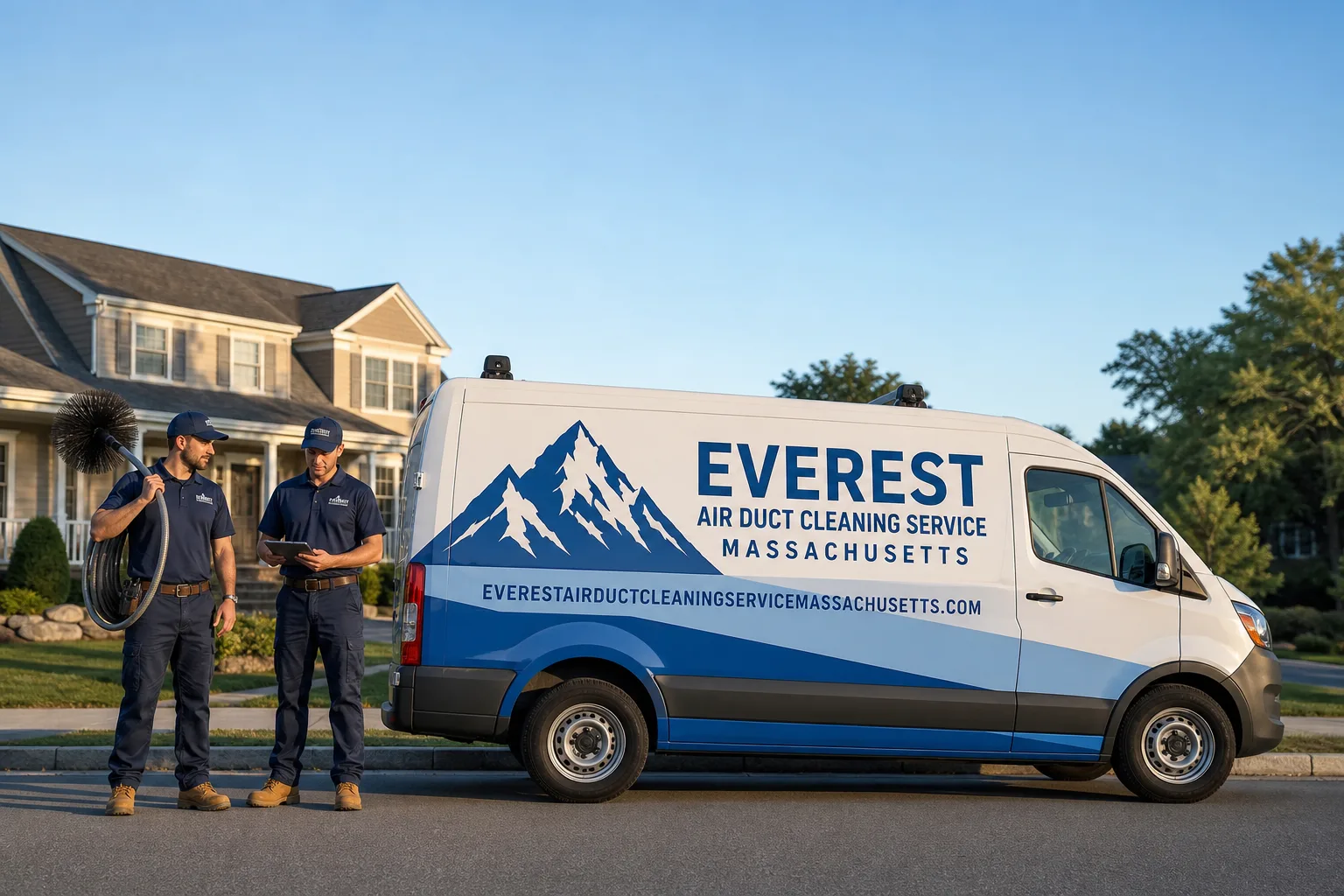
We’ve been driving to Lowell from our Boston base for 11 years, and Scott Gray still handles every job personally. Lowell isn’t a generic stop on a franchise route for us — it’s a city with distinct air-quality challenges that demand specific expertise. From the converted mill lofts along the Pawtucket Canal to the triple-deckers in the Acre and Centralville neighborhoods, we’ve worked inside duct systems that don’t resemble anything you’ll find in a suburban development built after 1980. The Merrimack River valley’s humidity patterns, the city’s 19th-century housing stock, and the unique contamination profile of retrofitted mill buildings all shape how we approach sanitizing here. When Lowell homeowners call, they’re getting Scott’s hands-on assessment — not a dispatcher sending an unknown technician.
Why Everest Air Duct Cleaning Service Massachusetts Is Lowell’s Preferred Air Quality & Sanitizing Company
Our Air Quality & Sanitizing team has built a reputation in Lowell by solving problems that other companies miss entirely. 617 customers have rated us 4.9 stars, and a significant portion of those reviews come from Lowell’s 01850, 01851, 01853, and 01854 ZIP codes — homeowners who specifically mention Scott’s thoroughness in identifying hidden contamination sources.
Response time to Lowell averages same-day or next-day for standard appointments, with emergency slots reserved for active mold, sewage backup contamination, or post-fire smoke odor situations. We know the difference between a quick fog-and-go treatment and actual remediation — and Lowell’s older housing stock punishes the shortcut approach every time.
Scott’s 11 years focused on one thing means he’s encountered Lowell’s specific failure modes repeatedly: the legacy cotton lint in mill-loft ducts, the cross-contamination between triple-decker units, the mold-prone cavities behind plaster-and-lath where retrofit ducts were shoehorned in. That pattern recognition translates to faster diagnosis and treatments that actually stick.
Our Air Quality & Sanitizing Services in Lowell
Mold Treatment
Mold in Lowell ductwork isn’t just a summer humidity problem — it’s a year-round issue amplified by the Merrimack River valley’s moisture-trapping geography and heating seasons that run from October through April. In older forced-air systems retrofitted into triple-deckers and mill buildings, vapor barriers were often never installed or have degraded after decades of thermal cycling. We find active mold colonization in supply plenums, trunk lines through shared wall cavities, and the irregular bends where ducts were routed through floor bays originally built for radiator pipes.
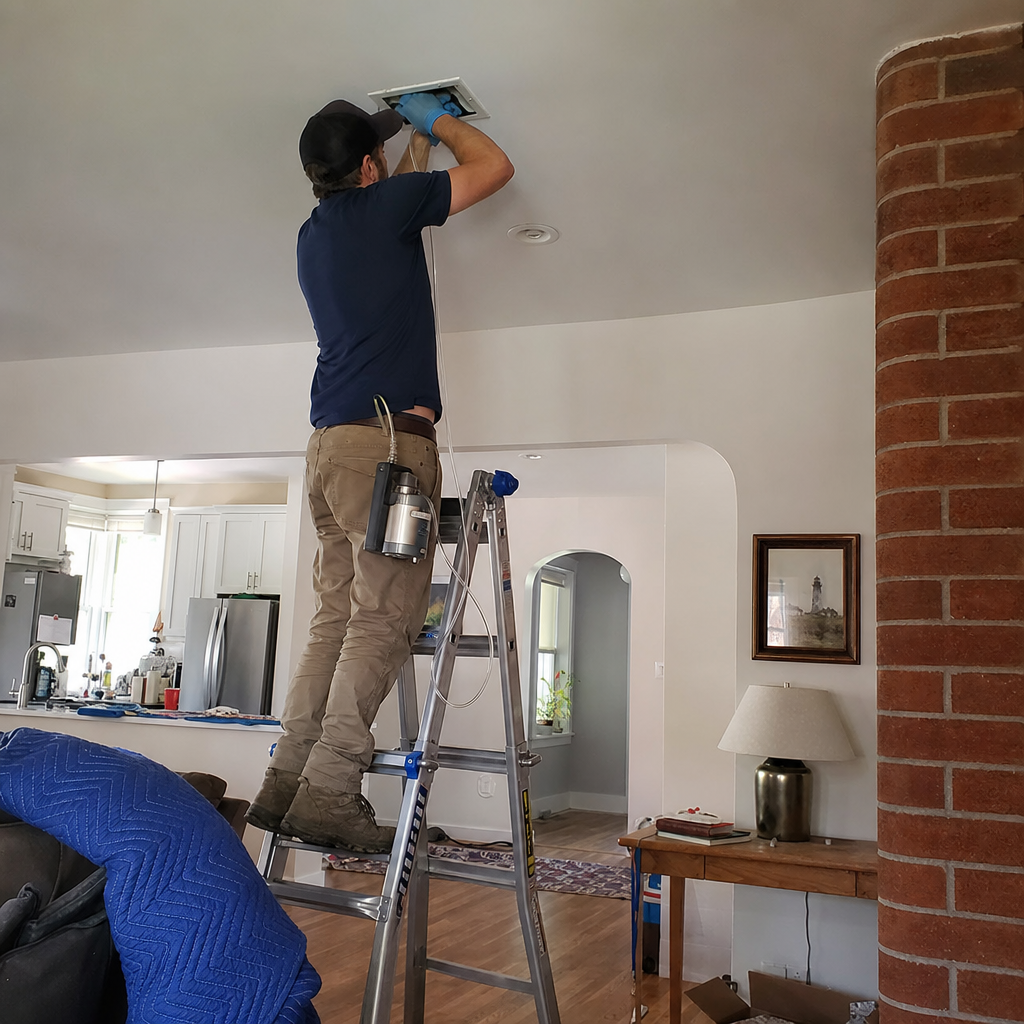
Our mold treatment protocol for Lowell properties starts with mechanical removal using Rotobrush agitation and Nikro HEPA vacuum extraction — surface fogging alone fails here because spores embed in legacy debris. We then apply antimicrobial treatment and, critically, identify and address the moisture source. In converted mill lofts, that often means finding where cotton lint has trapped condensation against duct seams for years.

Bacteria Sanitizing
Bacteria sanitizing in Lowell demands pre-cleaning protocols that standard residential services skip. In a converted mill loft on Market Street near the Pawtucket Canal, we found that the tenant’s recurring musty odor was not from mold but from decades-old cotton lint embedded in duct seams, trapping moisture and bacteria. Using our Rotobrush and a HEPA vacuum with a specialized agitation head, we extracted lint, then applied a Guardsman antimicrobial fog to the entire run — no neighbor in Tewksbury has this issue.
That legacy industrial fiber dust creates a unique contamination profile. Standard sanitizers bind to the lint rather than the duct surface, allowing bacteria to recolonize within weeks. Our Lowell protocol removes the substrate first, then treats the bare metal or properly sealed flex. For triple-decker units with shared wall cavities, we inspect whether cross-duct migration is reintroducing contamination from adjacent units — treating one side of a shared cavity while ignoring the other is a common reason sanitizing “doesn’t last.”

Odor Removal
Persistent odors in Lowell’s older housing stock rarely have a single source. In the Acre neighborhood’s triple-deckers, we routinely trace musty smells to a combination of mold in inaccessible trunk lines, cooking grease that migrated through shared wall cavities from the unit below, and pet dander accumulated in floor-return bays that were never designed as ductwork. Each layer requires a different approach: mechanical extraction for particulate, enzyme treatment for organic residue, oxidation for chemical odors.
Scott’s assessment distinguishes between odors that originate in the duct system and those being drawn into it from building cavities. In Centralville homes with original plaster-and-lath walls, we’ve found that “duct odor” was actually decaying mouse nests in wall cavities adjacent to poorly sealed return paths — sanitizing the ducts without sealing the building envelope would have wasted the customer’s money.

UV Light Installation
UV light installation in Lowell requires placement strategy that accounts for irregular duct geometry. Standard UV lamp positioning — centered in a straight trunk line — fails in mill-loft and triple-decker retrofits where ducts zigzag through structural cavities, creating shadow zones where microbial growth persists. We’ve seen installations by other companies where the lamp illuminated perhaps 40% of the actual air path.
Our Lowell UV installations use multiple smaller units or reflective housings to maximize coverage in tortuous runs. We specify Honeywell and Aprilaire UV systems with sufficient wattage for the actual duct volume, not the nominal square footage. In mill buildings with legacy lint contamination, we always pre-clean before UV installation — otherwise the light sterilizes dust surfaces while organisms thrive underneath.

What happens when you call
- 1
A real person answersNo phone trees — you reach a local pro.
- 2
You get an upfront price rangeHonest numbers before anyone is dispatched.
- 3
A background-checked tech heads outLicensed & insured, dispatched right away.
- 4
You approve before work beginsNothing starts until you say go.
Trusted Brands We Service in Lowell
We use Rotobrush brush-system technology and Nikro HEPA vacuums for mechanical cleaning, Abatement Technologies air scrubbers for containment during active mold work, and Guardsman antimicrobial products for sanitizing treatments. For filtration upgrades and UV installations, we work with Honeywell and Aprilaire systems — brands with established distribution in the Lowell area, meaning replacement parts and filter media don’t require extended ordering delays. We keep common filters and UV bulbs stocked for our Lowell customers because a sanitizing treatment loses effectiveness if the homeowner can’t maintain the upgraded filtration afterward.
Common Air Quality & Sanitizing Problems We See in Lowell Homes
- Legacy cotton lint in mill-loft ducts: Converted textile mills along the Pawtucket and Merrimack canal corridors harbor compressed industrial fiber dust in structural cavities retrofitted with ductwork. Standard residential cleaning protocols don’t account for this substrate, so sanitizers fail to bond with actual duct surfaces and bacteria recolonize within weeks.
- Cross-contamination between triple-decker units: In the Acre and Centralville neighborhoods, supply trunk lines often run through shared wall cavities between floor units. One unit’s cooking grease, pet dander, or smoke migrates into adjacent ductwork, meaning single-unit sanitizing treats symptoms while the source continues pumping contamination through the building.
- Mold in uninsulated retrofit cavities: Lowell’s Merrimack River valley humidity, combined with extended heating seasons, drives moisture into old plaster-and-lath wall cavities where forced-air ducts were later installed. Without vapor barriers, these cavities become mold incubators that standard duct cleaning never reaches.
- Shadow-zone microbial growth in irregular ducts: UV lights installed with standard centerline placement leave extensive shadow areas in the zigzag duct paths typical of Lowell’s retrofitted systems. Mold and bacteria persist in these untreated zones, causing odor recurrence that baffles homeowners who were told UV would “kill everything.”
Pricing for Air Quality & Sanitizing in Lowell, MA
| Service | Typical Range in Lowell |
|---|---|
| Bacteria sanitizing (standard residential system) | $275 – $425 |
| Mold treatment (localized, single zone) | $350 – $550 |
| Odor removal (complex/multi-source) | $400 – $650 |
| UV light installation (single unit, standard access) | $450 – $750 |
| Air purifier install (whole-house inline) | $800 – $1,400 |
| Allergen reduction package (cleaning + sanitizing + filtration upgrade) | $650 – $950 |
Lowell’s older housing stock pushes most jobs toward the higher end of these ranges. Mill-loft and triple-decker systems require more access points, longer cleaning time, and specialized pre-cleaning of legacy debris before sanitizing can be effective. Shared-wall cavity investigations add labor when cross-contamination is suspected. We provide upfront written estimates before any work begins — call (888) 597-5659 for yours. Estimates are free.
We Also Serve Cities Near Lowell
We regularly travel from Lowell to neighboring communities including Dracut, Chelmsford, Tyngsboro, and Tewksbury for air quality and sanitizing appointments. While Lowell’s mill-era housing presents unique challenges, these nearby cities have their own older-home profiles — mid-century ranches in Dracut, colonial-era farmhouses in Tyngsboro — that benefit from the same owner-led, equipment-serious approach Scott Gray brings to every job.
Serving Lowell, MA — Our Local Coverage Area
We’re based in the Lowell area and know this community well. Use the map below to see our service coverage — if you’re nearby, we can almost certainly help.
FAQs — Air Quality & Sanitizing in Lowell
Yes. In Lowell’s triple-deckers, particularly in the Acre and Centralville neighborhoods, we’ve documented cross-contamination where supply trunk lines share wall cavities between floor units. Cooking grease, pet dander, smoke, and even mold spores migrate through gaps in duct seams or unsealed building cavities. We inspect shared runs with borescope cameras and can seal cross-cavity pathways or recommend coordinated multi-unit treatment when the problem is structural. Call (888) 597-5659 if you’re experiencing odors or allergy symptoms you can’t trace to your own unit — estimates are free.
Only if the legacy lint is removed first. UV light sterilizes surfaces it directly illuminates, but mold and bacteria embedded in compressed cotton lint are shielded from exposure. In Lowell’s converted mill lofts, we always perform mechanical extraction of industrial fiber dust using Rotobrush agitation and HEPA vacuuming before considering UV installation. Post-cleaning, we position multiple UV units or reflective housings to address the irregular duct geometry typical of these retrofits. Call (888) 597-5659 for an assessment of your specific duct configuration — estimates are free.
Musty odors in Acre triple-deckers typically require a three-stage approach: mechanical extraction of accumulated debris, enzyme treatment for organic residues (cooking grease, pet dander, mold metabolites), and oxidation for chemical odor compounds. Surface fogging alone fails because odors penetrate into porous building materials and legacy lint deposits. We identify whether the source is in the duct system or adjacent building cavities — a distinction that determines whether sealing or remediation is the appropriate next step. Call (888) 597-5659 to schedule Scott’s assessment — estimates are free.
A brief burnt-dust odor at seasonal startup is common, but persistent or intensifying smells indicate accumulated debris burning off heating elements or microbial activity in damp duct sections. In Centralville’s older homes, we’ve traced chronic startup odors to decades of dust accumulation in floor-return bays originally built as gravity-air passages, not forced-air returns. The smell often worsens as heating season progresses because accumulated debris pyrolyzes with repeated heat cycles. We inspect and clean these inaccessible accumulations, then evaluate whether duct sealing is needed to prevent recontamination. Call (888) 597-5659 if the odor lasts more than a few heating cycles — estimates are free.
Yes — we typically recommend annual inspection and sanitizing every 18–24 months for Lowell’s converted mill lofts, compared to 2–3 year intervals for standard suburban homes. The legacy industrial fiber dust in these buildings creates a persistent contamination substrate that standard residential ductwork doesn’t harbor. Without regular monitoring, lint accumulation traps moisture and supports bacterial growth that would be impossible in a purpose-built system. We offer maintenance scheduling for our Lowell mill-loft customers to track contamination levels before they become odor or health issues. Call (888) 597-5659 to set up an inspection schedule — estimates are free.
Ready to improve your indoor air quality? Scott Gray personally handles every Lowell appointment, from assessment through treatment. Whether you’re dealing with persistent odors in a converted mill loft, mold concerns in a triple-decker, or simply want verification that your air system is genuinely clean, we’ll give you a straight answer and a clear plan. Call (888) 597-5659 today for your free estimate — no dispatchers, no rotating crews, just 11 years of specialized expertise applied to your specific Lowell home.
Written by Scott Gray, Owner at Everest Air Duct Cleaning Service Massachusetts, serving Lowell since 2014.