
Honeywell Air Duct Cleaning in Boston: A Homeowner’s Guide
Honeywell doesn’t manufacture duct cleaning equipment — they build the indoor air quality (IAQ) accessories that live inside your ductwork. Professional air duct cleaning in Boston with Honeywell components installed typically costs $350–$650 for a whole-home system, and the cleaning protocol changes depending on which Honeywell products you have. If you’d rather not sort out whether your UV light needs removal or your media filter can handle the airflow disruption, call us at (888) 597-5659 — Scott handles every job personally and will walk you through what’s actually in your ducts before we start.
Here’s the mistake we see constantly in Boston homes: homeowners search “Honeywell air duct cleaning” thinking it’s a branded service or specialized equipment, then get sold a package they don’t understand. We pulled a system apart last month in a 1920s Colonial over in Roslindale where the previous cleaner had blasted a Rotobrush straight through a Honeywell UV2400U — $400 in damaged bulbs because nobody checked what was mounted in the plenum. That shouldn’t happen, and it doesn’t when you know what you’re looking at.
What Honeywell Actually Makes for Your Duct System
Honeywell’s IAQ lineup breaks into four categories that matter for duct cleaning day. Each one changes how we approach your system:
- Whole-home media air cleaners (F100, F200, F300 series) — These mount at your air handler or return duct and use replaceable 4–5 inch pleated filters, typically MERV 11–16. During cleaning, we remove the filter cartridge to protect it from debris dislodgment, then reinstall fresh or clean existing depending on age.
- Electronic air cleaners (F300E, F50F series) — These use electrostatic precipitation and have powered cells that must be de-energized before any mechanical brushing or agitation. Water or cleaning solution contact with energized cells damages the ionizing wires. We power down at the breaker, tag it, and verify zero voltage before work begins.
- UV germicidal lights (UV2400U, UV100A, UC100E series) — Mounted in the supply plenum or evaporator coil housing. Bulbs are fragile, heat-sensitive, and expensive. We remove them entirely, store in padded cases, and reinstall after coil and plenum cleaning is complete. Never leave them in during agitation — vibration cracks the quartz envelope.
- Energy recovery ventilators (ERVs) and heat recovery ventilators (HRVs) — Less common in Boston’s older housing stock but appearing in newer Somerville and Seaport builds. These have their own duct runs that need separate cleaning consideration, especially the core media that can harbor mold in our humid summers.
In our 11 years focused on one thing, we’ve serviced Honeywell IAQ equipment in everything from Back Bay brownstones with original gravity furnaces retrofitted with modern air handlers to new construction in Dorchester with fully integrated F300E systems. The equipment’s solid — but it’s only as good as the contractor who knows how to work around it.
The Cleaning Protocol: What Happens to Your Honeywell Components
Here’s our field procedure for Boston homes with Honeywell IAQ installed, developed after seeing what goes wrong when cleaners treat every system the same:
- Pre-job inventory — We photograph every Honeywell component, record model numbers, and note installation date if visible. This takes 5 minutes and prevents the “what was here?” problem later.
- Power-down sequence — Electronic air cleaners and UV systems get de-energized at dedicated breakers, not just switches. We verify with a multimeter. Boston’s older electrical panels in Jamaica Plain and Mattapan homes often have non-obvious breaker labeling, so we trace circuits if needed.
- Component removal or protection — UV bulbs come out entirely. Media filters get removed and bagged. Electronic cells get extracted and set aside in protective casings. We clean the empty housings with HEPA-contained vacuums and low-pressure contact — no compressed air that could force debris into electrical connections.
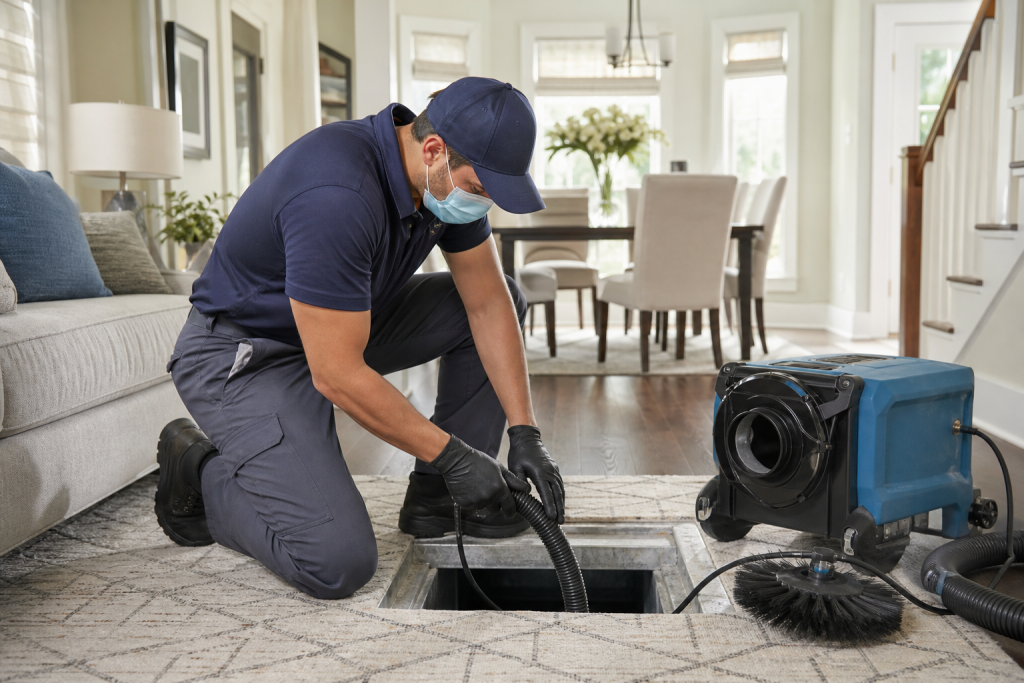
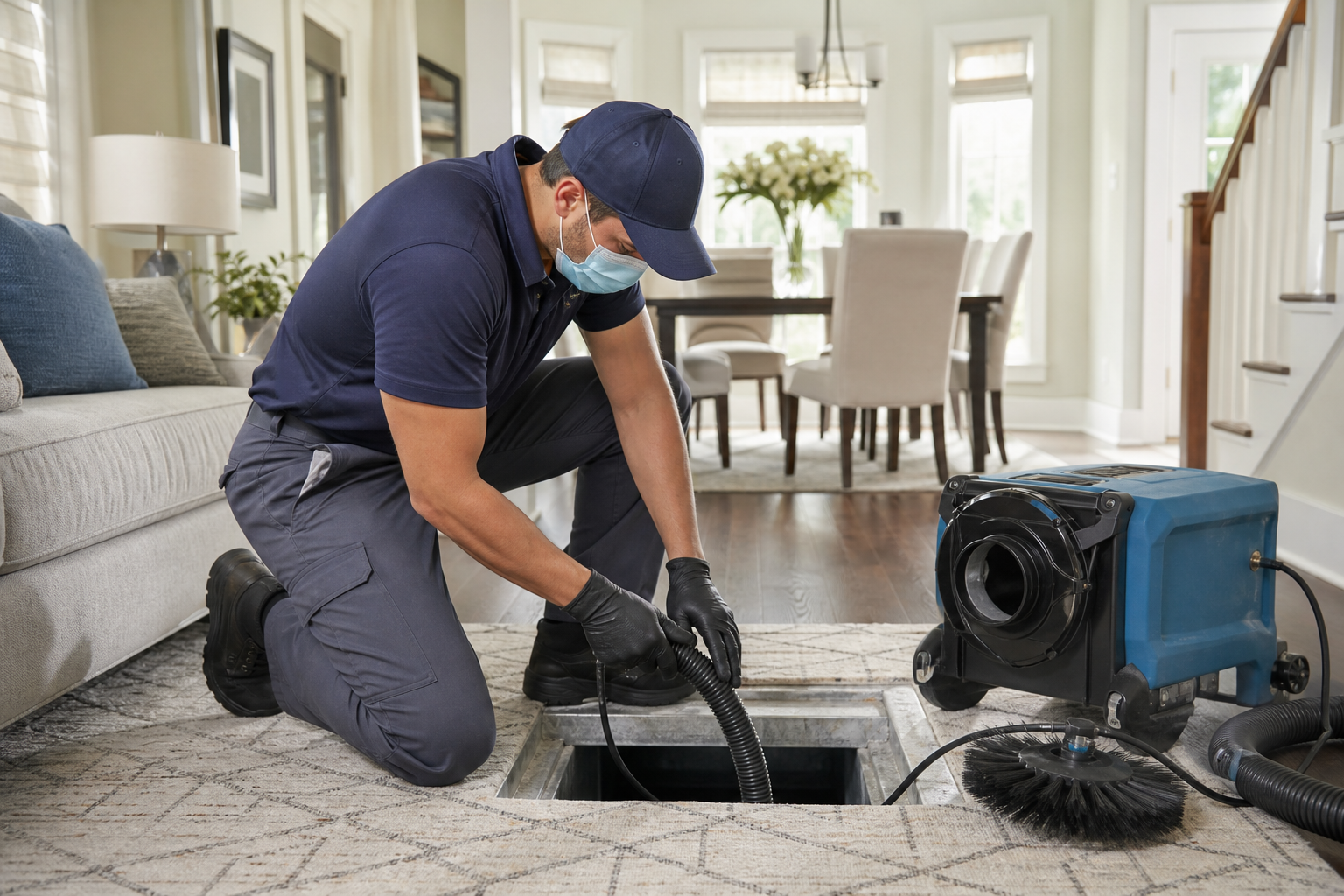
- Main duct cleaning — We use Rotobrush brush-system technology for the flex duct common in Boston’s retrofitted homes, and Nikro HEPA vacuums for rigid trunk lines. The Honeywell housings get hand-cleaned separately with Abatement Technologies air scrubbers running negative air pressure at the air handler.
- Reassembly and function test — Components back in, power restored, airflow verified. We check that electronic air cleaner indicator lights sequence properly and UV bulbs ignite without flicker. If a bulb’s past its 9,000-hour rated life, we note it — we sell replacements, but we’ll also tell you if Amazon’s cheaper for that part.
That last point matters: we’re not here to monetize every component touch. Scott handles every job personally, and the accountability means we can be straight about what’s worth buying from us versus sourcing yourself.
Which Honeywell Add-Ons Actually Move the Needle on Air Quality
This is where we part ways with the IAQ upsell culture. After 617 customers have rated us 4.9 stars, we’ve got enough feedback to know what people notice and what they don’t.
Worth the investment for most Boston homes:
- High-MERV media filters (F100/F200 with MERV 13–16 cartridges) — Measurable reduction in particulate, especially during our pollen-heavy springs and when wildfire smoke drifts east. Replace every 6–12 months depending on occupancy and pets. Real difference you can feel if you’re allergy-prone.
- UV-C coil sanitizing lights — Effective at preventing mold and biofilm buildup on wet evaporator coils, which is a real issue in Boston’s July-August humidity spikes. Doesn’t sterilize passing air — that’s physics, the dwell time’s too short — but keeps the coil itself from becoming a source.
Marginally beneficial, situationally:
- Electronic air cleaners — Good capture efficiency when maintained, but the cells need monthly washing (homeowner task) and performance degrades fast with neglect. We’ve pulled F300E cells in Allston that hadn’t been cleaned in two years — they were basically particulate sponges recirculating loaded material. If you’re not going to wash them, skip it.
Hard to justify the cost:
- Whole-home HEPA systems — Honeywell makes them, but the pressure drop in most Boston residential systems is significant. Your furnace blower may not be specced for it, and we’ve seen callbacks for reduced airflow and frozen coils. Media filters plus a portable HEPA unit in the bedroom usually outperform for less money.
- Ozone-generating “air purifiers” — Honeywell doesn’t push these anymore, but older units still circulate. We remove them on sight; ozone is a lung irritant and EPA-discouraged for occupied spaces.
The honest read: a thorough duct cleaning with a quality media filter change does more for most Boston homes than any IAQ gadget, especially if your ducts haven’t been cleaned in 5+ years or you recently finished renovation work.
How to Verify Your Contractor Can Actually Handle IAQ Equipment
Most duct cleaners in Boston will say they “work with all brands.” Here’s how to test that claim before you hire:
- Ask for the specific model — “I’ve got a Honeywell UV2400U in my supply plenum — do you remove the bulb before brushing?” If they hesitate or say “we’ll figure it out on site,” that’s a no.
- Request photo documentation — We photograph every IAQ component before and after. A contractor who can’t show you their pre-job protocol hasn’t developed one.
- Verify electrical lockout knowledge — Electronic air cleaners carry 120V or 240V. Ask how they verify zero energy state. If the answer is “we flip the switch,” keep looking.
- Check for reassembly testing — “Do you function-test the IAQ equipment after cleaning?” The correct answer includes specific verification steps, not just “we turn it back on.”
We use Rotobrush and Nikro equipment — industry-standard tools — but the tools matter less than the operator. Scott’s 11 years focused on one thing means he’s seen the failure modes most cleaners haven’t encountered yet. In Boston’s competitive market, the low-price outfits often can’t afford the training time or insurance exposure for proper IAQ handling. You find out which kind you hired when something breaks.
Post-Cleaning Maintenance: Honeywell Filters and System Baselines
After professional cleaning, your system’s performance baseline shifts — and your maintenance schedule should adjust too.
Filter replacement cycles post-cleaning:
- F100/F200 media filters (MERV 11–13) — Check at 6 months; replace at 9–12 months in typical Boston conditions. Post-cleaning, your first filter may load faster as residual dust settles out of suspension.
- F300 electronic cells — Wash monthly for first 3 months post-cleaning, then assess. Clean ducts mean less incoming load, so you may stretch to 6–8 weeks if occupancy is low and no pets.
- UV bulbs — Rated 9,000 hours (~1 year continuous). Replace on calendar, not visual — they still glow when germicidal output has dropped below effective levels.
What to expect after cleaning:
Airflow volume typically increases 8–15% in systems with significant prior buildup. That means your filter loads faster initially — the system is moving more air through the same media. We tell Boston customers to check their manometer or filter minder (if equipped) at 30 days instead of the usual 90.
Odor profile changes too. That “clean” smell people report is actually the absence of accumulated organic material off-gassing. If you had a Honeywell UV light installed, its effect on coil biofilm becomes more noticeable when the source load is gone — customers in humid neighborhoods like Hyde Park and West Roxbury often comment their AC smells “crisper” after we’ve cleaned and confirmed UV function.
We clean it, repair it, and seal it — and that includes verifying your IAQ equipment is actually contributing after the ducts are clear. A UV light in a filthy plenum is like a band-aid on a dirty wound.
When to Call a Pro
If you’ve got Honeywell IAQ equipment and can’t confirm when your ducts were last cleaned, or if you’re noticing reduced airflow, new odors, or your electronic air cleaner faulting more frequently, it’s worth an inspection. We don’t charge to look — estimates are free, and Scott handles every job personally. In Boston’s older housing stock, we regularly find that “duct cleaning” from five years ago was just a shop vac in the register boots, with the IAQ housing never touched.
Related services in Boston: Everest Air Duct Cleaning Service Massachusetts home for our full service overview, or Air Duct Cleaning in Worcester if you’re outside our immediate Boston service radius.
The Bottom Line
Honeywell makes excellent IAQ equipment, but it requires knowledgeable handling during duct cleaning — equipment that gets damaged or bypassed defeats the purpose of the service you’re paying for. In Boston’s market of generalist HVAC companies and franchise dispatchers, finding a technician who knows the difference between a UV2400U and an F300E cell is harder than it should be.
We use Rotobrush and Nikro equipment, we name the tools because specificity signals expertise, and after 11 years focused on one thing, we’ve developed protocols that protect your investment rather than treat it as an obstacle. 617 customers have rated us 4.9 stars — not because we’re the cheapest, but because we return systems with everything intact and functioning.
If you’re in Boston and need help sorting out what’s actually in your ducts, Everest Air Duct Cleaning Service Massachusetts offers free estimates — call (888) 597-5659. Scott answers the phone and runs the job, so you’ll get a straight answer about whether your Honeywell components need attention, protection, or replacement.
Frequently Asked Questions
No — Honeywell doesn’t certify duct cleaners. What you need is a technician who knows how to identify, de-energize, remove, and reinstall Honeywell IAQ components without damage. Ask specifically about their protocol for UV lights and electronic air cleaners; vague answers are red flags. Call (888) 597-5659 and ask for Scott — he’ll walk you through exactly how we handle your model.
Only if the cleaner doesn’t know what they’re doing. UV bulbs must be removed before mechanical agitation; electronic cells need electrical lockout and physical extraction. We document every component with photos before starting, and we function-test after reassembly. In 11 years, we’ve never damaged a customer’s IAQ equipment because we don’t guess — we remove and protect.
Whole-home duct cleaning in Boston typically runs $350–$650 for a standard residential system. Honeywell IAQ components don’t usually add cost if they’re properly accessible — we include removal and reassembly in our base service. If your UV bulbs need replacement or electronic cells require deep cleaning beyond standard maintenance, we’ll quote that separately before proceeding. Estimates are free — call (888) 597-5659 for exact pricing.
After — always after. A fresh filter installed before cleaning gets immediately loaded with dislodged debris. We remove and bag existing filters during service, then install new media (or reinstall recent cartridges if they’re still viable) as our final step. If you buy your own F100/F200 cartridges, hold them until we’re done. We’ll install them and record the date for your maintenance tracking.
Written by Scott Gray, Owner & Lead Technician at Everest Air Duct Cleaning Service Massachusetts, serving Boston since 2015.
Need Air Duct Cleaning Help?
Call Everest Air Duct Cleaning Service Massachusetts — licensed & insured, here with fast after-hours help in Massachusetts.
(888) 597-5659